serde and lossless, comment-preserving editing for YAML 1.2, in one
crate. Both run on one parser and one interpretation of the file, so a
typed read and an edit never disagree about what it means. Correct by
default, no unsafe, no panics on any input.



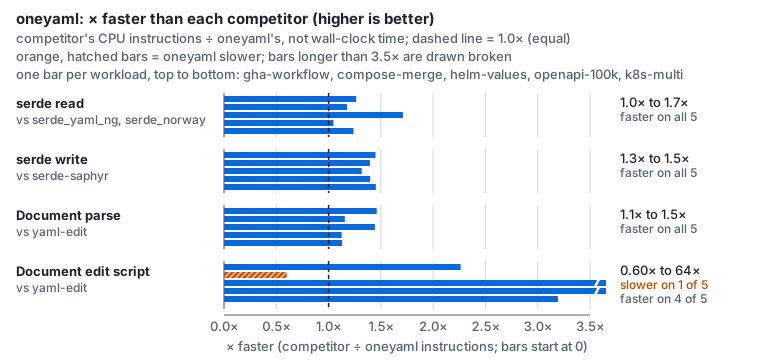
How many times fewer CPU instructions oneyaml executes than each
competitor (the fastest feature-complete serde library for serde reads
and writes, yaml-edit for Document parsing and a three-edit script),
on five workloads shaped like real configuration files (higher is
better; hatched bars are workloads where oneyaml is slower):
Full results, with wall-clock times and the method →
Why oneyaml
- One parser, one meaning. serde and the lossless
Documentread the same events through the same resolver, so a typed read and an edit never disagree about what a file means; a test checks that they agree on every corpus file (consistency.rs). - Edits that keep your file.
Document::parse(src)?.to_string() == src, byte for byte, on every valid file of the yaml-test-suite (round trip). An edit changes only what you touch: every comment stays with the entry it belongs to, also when you move the entry, by numbered rules, and new content is laid out like its neighbours. JSON Patch and merge patches change values the same way, all or nothing (a patchmovecarries the value without its comments) (patches and pointers). - Correct YAML 1.2.2 by default. The Core schema reads
yesas a string and0777as a decimal integer, as the spec says; the Failsafe and JSON schemas are built in. Every YAML 1.1 behaviour, merge keys included, and every leniency is a named setting, off by default (known deviations). yaml-test-suitedata-2022-01-17, 402 cases: 402/402 under the standard criterion (valid 308/308, error 94/94), 402/402 strict (exact events, error prefixes and codes), and 308/308 valid inputs round-trip byte for byte (evidence, other Rust parsers' scores and how to reproduce). - Safe on any input. Every published crate is
#![forbid(unsafe_code)]. Every input gives a value or an error, every fallible API returnsResultorOption, and parsing is iterative, so deep nesting can't overflow the stack. Every read enforces resource limits; for input from the network, useLimits::untrusted(). Parsing, serde, editing, comments and diagnostics are fuzzed (crates/fuzz) and tested againstserde_yaml_ng, saphyr, yaml-rust2, libyaml and yaml-edit. - Errors you can act on. Every error has a stable
Y####code, a span and a path, and common mistakes come with a suggested fix (diagnostics). - Fast, with the losses shown. oneyaml executes fewer instructions than each competitor on every workload in the chart above but one, and the cost of a measured edit depends on what it touches, not on the file's size (a patch also reads the keys of each mapping it looks into, once per patch). It isn't faster everywhere: yaml-edit edits the smallest file in fewer instructions and less time, a typed read of the OpenAPI workload is slower in wall-clock time, and some serde reads outside the chart are slower or level (every loss).
The only runtime dependency by default is serde
(feature flags). How oneyaml compares with
serde_yaml_ng, serde_norway, serde-saphyr and yaml-edit, including
where they win:
docs/comparison.md.
Install
cargo add oneyaml serde -F serde/deriveQuick start
Read and write typed data with serde, then edit a document in place: the edit changes only what you touched, and the comment stays.
use oneyaml::Document;
use serde::{Deserialize, Serialize};

#[derive(Deserialize, Serialize)]
struct Config { name: String, port: u16 }

fn main() -> Result<(), Box<dyn std::error::Error>> {
    // serde: read and write typed data.
    let cfg: Config = oneyaml::from_str("name: web\nport: 8080\n")?;
    assert_eq!(oneyaml::to_string(&cfg)?, "name: web\nport: 8080\n");

    // Read values from a document.
    let mut doc = Document::parse("server:\n  port: 8080  # public\ntags: [web]\n")?;
    assert_eq!(doc.get_path("server.port").and_then(|n| n.as_u64()), Some(8080));

    // Edit it: everything else, comments included, stays byte for byte.
    doc.set_path("server.port", 9090)?;
    doc.get_mut("tags")?.push("api")?;
    assert_eq!(doc.to_string(), "server:\n  port: 9090  # public\ntags: [web, api]\n");
    Ok(())
}
Diagnostics
An error says what went wrong, where, and how to fix it. Display is one
line for logs; Error::render
prints a rustc-style snippet of your source with a stable Y#### code,
labels, help, the path to the value, and a suggested fix you can apply:
use serde::Deserialize;

#[derive(Deserialize)]
struct Config { debug: bool }

fn main() -> Result<(), Box<dyn std::error::Error>> {
    // `yes` is a boolean in YAML 1.1 but a string in YAML 1.2.
    let src = "debug: yes\n";
    let err = oneyaml::from_str::<Config>(src).err().ok_or("expected an error")?;
    assert_eq!(err.render(src), r#"error[Y3000]: invalid type: string "yes", expected a boolean; YAML 1.2 reads `yes` as a string (its booleans are `true` and `false`)
 --> 1:8
  |
1 | debug: yes
  |        ^^^
  |
  = help: write `true` instead of `yes`, or read the YAML 1.1 booleans (y/n, yes/no, on/off) as booleans with Settings::yaml11_booleans(true) or the Compat::yaml_1_1() preset
  = path: debug
  = suggestion (may be incorrect): write the YAML 1.2 boolean `true`: replace `yes` with `true`
"#);
    let fix = err.diagnostic().suggestions.first().ok_or("no fix")?;
    assert_eq!(fix.apply(src).as_deref(), Some("debug: true\n"));

    // A forgotten `]`: the error points at the `[` that is still open
    // and offers to close it after `443`.
    let src = "ports: [80, 443\nimage: nginx\n";
    let err = oneyaml::Document::parse(src).err().ok_or("expected an error")?;
    let fix = err.diagnostic().suggestions.first().ok_or("no fix")?;
    assert_eq!(fix.apply(src).as_deref(), Some("ports: [80, 443]\nimage: nginx\n"));
    Ok(())
}
A fix is marked machine-applicable only when applying it can't change
what the rest of the file means; any other fix, like the two above, is
labelled for review. Codes are never reused, and limit errors name the
setting to raise.
Document::parse_recovering
keeps going past the first error, so you see a file's errors together,
and the
miette feature plugs errors into miette's reports. More on
diagnostics on Error.
Patches and pointers
A Document applies JSON Patch (RFC 6902) operations on YAML, and merge
patches (RFC 7396), all or nothing: if any operation fails, the document
is exactly as it was. A patch changes only the text of the values it
names, so the comments and layout around them stay:
use oneyaml::{Document, MergePatch, Patch, PatchErrorKind};

fn main() -> Result<(), Box<dyn std::error::Error>> {
    let mut doc = Document::parse("# app\nimage: web:1.0  # pinned\nports: [80]\n")?;
    let patch = Patch::from_json(
        r#"[{"op": "test", "path": "/image", "value": "web:1.0"},
            {"op": "replace", "path": "/image", "value": "web:1.1"},
            {"op": "add", "path": "/ports/-", "value": 443}]"#,
    )?;
    doc.apply_patch(&patch)?;
    assert_eq!(doc.to_string(), "# app\nimage: web:1.1  # pinned\nports: [80, 443]\n");

    // The `test` fails now, so nothing is applied.
    let err = doc.apply_patch(&patch).err().ok_or("expected an error")?;
    assert_eq!(err.kind(), PatchErrorKind::Test);
    assert_eq!(doc.get_pointer("/ports/1")?.as_u64(), Some(443));

    // A merge patch: `null` removes a key.
    let mut doc = Document::parse("image: web:1.0  # pinned\nenv:\n  DEBUG: \"1\"\n  LOG: info\n")?;
    doc.apply_merge_patch(&MergePatch::from_json(r#"{"image": "web:1.1", "env": {"DEBUG": null}}"#)?)?;
    assert_eq!(doc.to_string(), "image: web:1.1  # pinned\nenv:\n  LOG: info\n");
    Ok(())
}
Document::get_pointer
reads a node by JSON Pointer, and DocumentMut and Stream apply
patches too. To change one value without a patch, the setters
(Document::set_path,
NodeMut::set)
write exactly the value you give and keep the old value's style: a
block scalar stays a block scalar, quotes stay, and so does a tag that
still fits.
Patches work on the YAML data model, so they differ from JSON Patch in a
few places: test compares YAML values (1 is not 1.0), a pointer
token matches a key by its text, and writes below an alias or to a key
merged in by << are refused. copy and move write the value, not its
text: the comments and anchors inside a moved value are dropped. To move
an entry with its comments, use
NodeMut::move_entry
or
Removed.
Patch lists every difference and what each operation keeps, and
says what a successful patch guarantees. Patch::from_json also reads
YAML text, with the default limits; for untrusted text, read a Value
with from_str_with and Limits::untrusted() and build the patch with
Patch::from_value.
When not to use oneyaml
- You need the fastest serde reads in wall-clock time. oneyaml's
serde reads use fewer instructions on most workloads, but in
wall-clock time
serde_yaml_ngorserde_norwayis faster on some of them: typed reads of the OpenAPI workload, most reads into structs that use a few fields, and some reads intoValue(serde read wall-clock). - You make a few edits to many small files and edit speed matters. Below a few kilobytes, yaml-edit's edits cost fewer instructions and less wall-clock time (compose-merge in the chart above; see the benchmark tables).
- You need something oneyaml doesn't do:
no_std, async I/O, schema validation, templating, building objects from tags, or editing a file too large to hold in memory (Documentkeeps the whole tree; serde reads don't). - You want
serde_yaml's exact behaviour with no review.Compat::serde_yaml()gets close, but some differences are deliberate; the migration guide lists every one. - You need a long production track record.
serde_yaml's lineage has years of it; oneyaml is new.
Untrusted input
Every entry point enforces resource limits (depth, alias expansion,
document size, scalar length, document count). The default profile suits
configuration files; for input from the network, use
Limits::untrusted():
use oneyaml::{Limits, Settings, Value};

fn main() -> Result<(), Box<dyn std::error::Error>> {
    let settings = Settings::new().limits(Limits::untrusted());
    let small = "a: &a [x, x]\nb: &b [*a, *a]\nc: &c [*b, *b]\n";
    let v: Value = oneyaml::from_str_with(small, &settings)?; // small: fine
    assert_eq!(v["c"][0][1][0].as_str(), Some("x"));

    // "Billion laughs": ten levels of ten aliases each.
    let mut laughs = String::from("l0: &l0 [lol]\n");
    for i in 1..10 {
        let refs = vec![format!("*l{}", i - 1); 10].join(", ");
        laughs.push_str(&format!("l{i}: &l{i} [{refs}]\n"));
    }
    let refused = oneyaml::from_str_with::<Value>(&laughs, &settings);
    assert_eq!(refused.err().map(|e| e.code()), Some(oneyaml::code::ALIAS_BUDGET_EXCEEDED));
    Ok(())
}
There are three profiles: Limits::default(), Limits::untrusted() and
Limits::unlimited(), the only one without alias budgets (for input you
trust completely). Exceeding a limit is an error whose help names the
setting to raise. The alias budgets count the nodes and bytes that alias
expansion produces beyond the input, and an alias whose whole expansion
would exceed a budget is refused before it is replayed, so "billion
laughs" fails fast. Document never expands aliases, and compatibility
presets never change limits. The values of each profile and how the
budgets are counted are on
Limits.
Merge keys (<<)
YAML 1.2 has no merge keys: by default << is an ordinary string key,
as the spec says. docker-compose files and many CI configurations rely on
the YAML 1.1 merge-key extension; turn it on with one setting:
use oneyaml::{Settings, Value};

fn main() -> Result<(), Box<dyn std::error::Error>> {
    let src = "base: &b {image: nginx, replicas: 2}\nweb:\n  <<: *b\n  replicas: 3\n";
    let v: Value = oneyaml::from_str_with(src, &Settings::new().merge_keys(true))?;
    assert_eq!(v["web"]["image"].as_str(), Some("nginx"));
    assert_eq!(v["web"]["replicas"].as_u64(), Some(3));
    Ok(())
}
Compat::yaml_1_1() turns on every YAML 1.1 behaviour, merge keys
included; Compat::serde_yaml() leaves them off, as serde_yaml's
deserializer does. Merges through aliases count toward the alias budget.
Document keeps << entries as written and edits them like any other
entry; examples/compose_merge.rs
edits a docker-compose file that uses them. Details:
Settings::merge_keys.
Going further
The API reference on docs.rs has a worked, tested example for each task, and the guides in the repository cover the rest:
- Read and edit a document.
Documentwalks the core path (parse, look up, edit, write), says how new content and set values are written, and lists what an edit refuses;NodeRefcovers typed reads, spans anddeserialize;NodeMutcovers edits in depth, andRemovedcovers moving an entry. Paths are strings ("spec.containers[0].image") orpath!values; the syntax, and how to quote a key that holds a., are onIntoPath. - Apply patches.
Document::apply_patchandapply_merge_patchcover what each operation writes, how a pointer token matches a key, and the limits a patch is held to;PatchErrornames the operation that failed. - Keep and edit comments. Each comment has an owner, set by the
comment attachment rulebook;
edits move comments with their owner, and
explain_commenttells you which rule decided. See comments onDocument. - Multi-document files, anchors and aliases. A file with several
documents is a
Stream, read and edited one document at a time (or iterated with serde). Editing an anchored node is seen through every alias; see anchors and aliases. - Diagnostics and recovering parses. Every error has a
Y####code (code), a span, a path and, for common mistakes, a fix you can apply; see diagnostics onErrorandRender.Document::parse_recoveringnever fails, and you can still read and edit everything outside the broken regions. - Serialize and configure.
to_stringandto_writerwrite anySerialize, quoting every string that some reader would read as something else. Every reading and parsing entry point has a*_withtwin (Patch::from_jsonandMergePatch::from_jsonexcepted: they read with the defaults) that takes an explicitSettings(there are no globals): the schema, YAML 1.1 behaviours, duplicate-key handling, output layout (Emit) and resource limits (Limits). - Migrate from
serde_yaml. The entry points keepserde_yaml's names (from_str,from_slice,from_reader,to_string,to_writer,from_value,to_value,Value,Mapping,Deserializer,Serializer), so migrating starts with auseswap, andCompat::serde_yaml()reads and writes asserde_yamldoes where YAML 1.2 allows. The migration guide walks through it and lists every remaining difference with its reason. - Performance in detail. Results at a glance has the numbers behind the chart as tables (absolute instruction counts, both ratios, wall-clock time, every workload where oneyaml is slower and the machine they were measured on); the rest of docs/performance.md covers every workload, memory, scaling and how to reproduce it all.
- Real-world programs.
examples/starts withedit_config.rs(the quick start as a program), then edits a Kubernetes manifest, a GitHub Actions workflow and a docker-compose file with merge keys, checking every comment's owner before and after. Run one withcargo run -p oneyaml --example k8s_manifest.
Feature flags
All are off by default; without miette and serde_json, the only
third-party runtime dependency is serde.
miette:Errorimplementsmiette::Diagnostic(code, severity, labels, help with the suggested fixes, and a documentation URL per code);DiagnosticReportdoes the same for aDiagnostic. Addsmiette7 without its default features (it bringscfg-ifandunicode-width).serde_json:TryFromconversions betweenValueandserde_json::Valuein both directions, andValue::to_json_with. What has no JSON form (tags, non-string keys,.nan/.inf, integers beyond 64 bits, nesting past 128 levels) is an error with its path, never a silent coercion; the full table is onValue::to_json_with. Addsserde_jsonwith only itsstdfeature.__internal-checks(unstable, not covered by semver): test-only consistency checks used by this crate's own test suites and fuzzers. Never enable it in a library or application.
Minimum supported Rust version
Rust 1.85 (edition 2024), for oneyaml, oneyaml-core and
oneyaml-syntax. The MSRV is rolling: it may move to any stable release
at least 12 months old, only in a minor release, and every move is
announced in the
changelog.
License
Licensed under either of
- Apache License, Version 2.0 (LICENSE-APACHE or <https://www.apache.org/licenses/LICENSE-2.0>)
- MIT license (LICENSE-MIT or <https://opensource.org/licenses/MIT>)
at your option.
Unless you explicitly state otherwise, any contribution intentionally submitted for inclusion in oneyaml by you, as defined in the Apache-2.0 license, shall be dual licensed as above, without any additional terms or conditions. See CONTRIBUTING.md and SECURITY.md.